Disaster Risk Management in Colombia is a comprehensive and mandatory social process for authorities and citizens. Its objective is to guarantee safety and sustainable development

Disaster risk management is a social process aimed at formulating, implementing, monitoring, and evaluating policies, strategies, plans, programs, regulations, instruments, measures, and permanent actions for knowledge, risk reduction, and disaster management, with the explicit purpose of contributing to the safety, well-being, quality of life of people, and sustainable development. This process is the responsibility of all authorities and inhabitants of the Colombian territory.
Disaster risk management is achieved through the implementation of the following processes: Risk Awareness, Disaster Risk Reduction, and Disaster Management.
It is the process of risk management, consisting of the identification of risk scenarios, risk analysis and assessment, monitoring and tracking of risk and its components, and communication to promote greater awareness of risk, which feeds into risk reduction and disaster management processes
Advocate and influence all levels of government in relation to DRM, contributing to the implementation of Law 1523 of 2012 and Law 1505 of 2012 (First Response Volunteer Law), to ensure adequate disaster-related rights in the country, promoting the adoption of regulations.
Develop training and capacity building in DRM individually or in partnership with other entities of the SNGRD, the IFRC, United Nations agencies, Participating National Societies (PNS), NGOs, educational institutions, the private sector, and other organizations to promote learning on the subject. This includes: Educational Brigades
Promote the development of innovations in research and knowledge that enable improvements in DRM; strengthen information and telecommunications technologies to optimize our intervention in DRM processes through strategic alliances with academia, industry, and technology centers, promoting systematization, capitalization, and dissemination at the national and international levels.
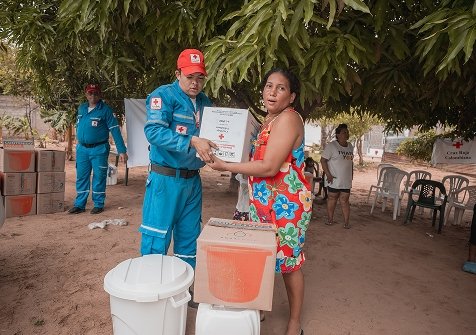
It is the process of risk management consisting of intervention aimed at modifying or reducing existing risk conditions, i.e., risk mitigation, and preventing new risks in the territory, i.e., risk prevention. These are mitigation and prevention measures that are adopted in advance to reduce the threat, exposure, and vulnerability of people, livelihoods, property, infrastructure, and environmental resources, in order to avoid or minimize damage and losses in the event of dangerous physical events.
Risk reduction consists of corrective action on existing risks, proactive action on new risks, and financial protection.
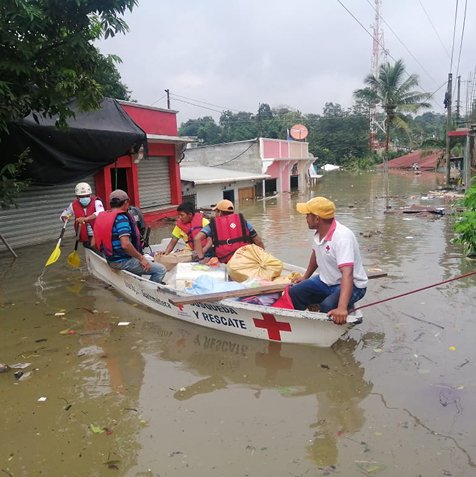
Developing, building, repairing, or modernizing community and/or public infrastructure, as well as rebuilding the social fabric, is an essential part of the Colombian Red Cross’s holistic approach and plays an important role in the development and/or rehabilitation of living conditions in communities. Emphasizing the importance of reestablishing or developing empowered community organizations, with participatory leadership and planning, to build resilience.
Promote the protection, provision, restoration, strengthening, and diversification of livelihoods, facilitating empowerment and access to resources, so that people have the capacity to make decisions about their livelihoods. Facilitate the development of sustainable livelihoods for food security, income generation, and employability in DRM processes, with the aim that our actions do no harm and seek to develop community resilience. This includes: Cash Transfers, Food Security, and Income Generation.
Strengthen preparedness and capacities for emergency response at the individual, community, and local authority levels through training, provision of resources, and improvement of procedures in the event of potential disaster scenarios. To this end, coordinated efforts will be made with the Territorial DRM Councils (departmental, municipal, and district), the student population, communities, and the public and private sectors. This includes: Community Risk Reduction, Road Safety, Early Warning Systems (SAT), Urban Risk and Resilience, and Educational Brigades.
Raise awareness among individuals and communities about the effects of climate variability and change on populations, and develop educational and adaptation measures to address these phenomena.
Process description: This is the risk management process consisting of preparing for emergency response, preparing for post-disaster recovery, executing that response, and executing the respective recovery, understood as rehabilitation and recovery.
Promote and develop actions aimed at providing humanitarian assistance and strengthening the capacities of vulnerable families or those affected by disasters caused by natural or anthropogenic phenomena, in order to mitigate the impact and vulnerability that such situations produce, when there is a lack of decent conditions in terms of water and basic sanitation services to which they are entitled as human beings; not only focusing on first response actions, but also seeking to develop preparedness and recovery actions. Using an integrated approach where water distribution and sanitation activities will be complemented by awareness-raising and hygiene training activities, seeking a comprehensive approach in all actions.
Apply a comprehensive approach that frames the strategy for temporary shelter, improvement, adaptation, and eventual reconstruction of homes. Carry out shelter activities with an integrated perspective on water, sanitation, and hygiene and a focus on capacity building, coordinated with response strategies and framed in the context of complementarity.
Support other National Societies through the IFRC, ICRC, or bilaterally, when necessary and requested, with certified equipment and streamlined procedures that enable this assistance to be provided quickly and to high standards.
Develop disaster management actions that complementarily protect and address the needs of affected persons in terms of basic humanitarian assistance, health care, and psychological support, in accordance with applicable standards and norms that promote the human dignity of affected persons. This includes: emergency logistics and cash transfers.
Promote the development of professional teams to assist those affected in the early hours. The Colombian Red Cross will provide training and manage resources from donors to support basic equipment, in order to strengthen the various search and rescue specialties, enabling activities to be carried out with the highest quality at the national and international levels, taking into account the safety of its members, as well as the application of standardized procedures that allow for the integration of actions in operations involving different technical teams or other entities or agencies.
Work in coordination with the various actors involved in humanitarian assistance for migrants, seeking to address and mitigate their risk situation, facilitating adaptation and integration processes, in accordance with state public policies, from a regional and territorial perspective.
Promote the transparent, effective, and appropriate development of the institutional mission within and outside the national territory, through compliance with security regulations, to ensure safe access to intervention areas.
Maintain the CRC’s HF and VHF communication systems in the country, as well as the training of volunteer and employee personnel. Interact with public, private, and PNS entities in the development of activities that strengthen the CRC. Through the maintenance of the national HF and VHF network, implementation of Early Warning Systems (SAT), training, ODK and Mega V, and technical support in emergency operations.
Recognize and strengthen the work of volunteers in DRM processes, promoting an enabling environment, improving their operational and technical capacities, as well as the conditions for the work they carry out in emergencies and disasters.
At the Colombian Red Cross, we want to be close to you, especially when you feel anxiety, sadness, or stress. Additionally, if you have any concerns or complaints about our services, this space is open to listen and help you.